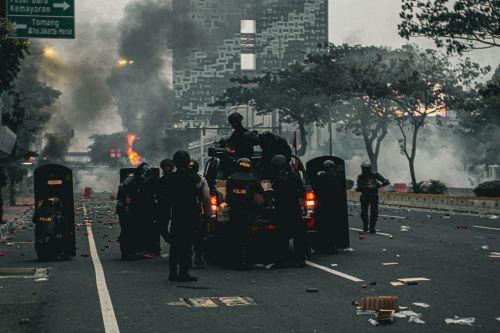
Best Places to Shelter During Urban Riots
Finding safe shelter during an urban riot means avoiding confrontation, staying out of high-traffic areas, and securing a defensible position. Riots can erupt suddenly, triggered by political unrest, economic collapse, or civil disputes. Once chaos spreads, police and emergency services become unreliable.
Sheltering effectively means minimizing exposure to violence, looting, and unpredictable crowds while maintaining access to essential supplies and escape routes. The best shelter is one that blends in and doesn’t attract attention. If rioters don’t know you’re there, they have no reason to target you.
Related: Evacuation Plans: GOOD – Get Out Of Dodge!
High-profile locations like government buildings, police stations, and known supply hubs (supermarkets, pharmacies, banks, and gas stations) should be avoided. These are the first places looters and violent mobs target, and authorities often set up barricades, use force, or conduct mass arrests in these areas.
Residential buildings, particularly those with limited street-level access, are among the safest places to shelter. Multi-story apartment complexes with reinforced doors, rooftop access, and secondary exits allow for safer, long-term refuge. Avoid units on the ground floor, as these are easier to break into.
Sheltering in a single-family home should have a fenced yard, security cameras, or a high-walled perimeter to deter opportunistic criminals. Closing blinds, reducing noise, and using minimal lighting make the home appear unoccupied, reducing the risk of looters targeting it.
Industrial buildings, office complexes, or warehouses can provide temporary refuge if a rioter cannot access a secure home. These structures are typically stronger than retail stores and less likely to be looted unless they hold valuable goods.
Buildings with few street-facing windows, gated access, and emergency stairwells offer better protection. If possible, securing an area above ground level with only one or two access points allows for better control over entry.
Hotels can be both a risk and an asset. If they are in the riot’s path, they may be overrun by desperate people seeking refuge or looters targeting valuables. However, if managed carefully, a high-rise hotel with keycard access, a solid security presence, and rooftop exits can provide a defensible position. To increase safety, avoid using the lobby or high-visibility hallways—instead, find a maintenance room, locked storage area, or staff quarters away from main corridors.
If movement is necessary during a riot, underground spaces like subways, tunnels, or parking garages offer temporary concealment. Basements and underground maintenance tunnels can shield against gunfire, fires, and stampedes, but they risk being trapped if exits are blocked or flooded. These should only be used as a short-term hiding place until it is safe to relocate.
Churches, community centers, and schools are sometimes used as makeshift safe zones, but they can also attract large crowds seeking shelter, making them potential targets. If a church or school is not widely known as an evacuation site, it may serve as a discreet refuge, but once overrun, it becomes a liability.
Avoiding public transit hubs like bus stations, train depots, and airports is critical. These areas become choke points where police, military, and panicked civilians all converge, leading to unpredictable violence, mass arrests, or being trapped without an escape route.
If rioters breach your shelter, staying silent and hidden is often better than engaging. Barricading doors, using alternate exits, and having a concealed escape plan are essential. If evacuation is necessary, alleyways, back streets, rooftops, or underground routes prevent running directly into hostile crowds.
The best shelter during an urban riot provides concealment, controlled access points, and an escape route. Staying out of sight, reducing noise, and ensuring basic survival needs like food, water, and protection ensure the highest chance of escaping the chaos unscathed.
Best Non-Lethal Self-Defense Weapons for Urban Survival
Non-lethal self-defense weapons offer a critical advantage in urban survival scenarios where carrying firearms or knives may be illegal, impractical, or escalate a situation unnecessarily. In a conflict zone, an occupied city, or a high-crime area, the ability to defend yourself without attracting undue attention or resorting to deadly force can mean the difference between survival and unwanted retaliation.
The best non-lethal weapons are concealable, effective at creating an opportunity to escape, and don’t require extensive training to use under stress.
A tactical flashlight is one of the most underrated self-defense tools. A 1,000-lumen flashlight with a strobe function can temporarily blind an attacker, causing disorientation and giving you time to escape.
Many models have striking bezels, allowing them to be used for close-quarters striking against soft targets like the eyes, throat, or groin. Tactical flashlights are legal in nearly all locations, don’t raise suspicion, and serve a dual purpose as a light source in low-visibility conditions.
Pepper spray is an effective range deterrent, capable of incapacitating an attacker for several minutes. The best options use OC (oleoresin capsicum), a derivative of chili peppers, which causes intense burning, involuntary eye closure, and respiratory distress.
A well-aimed spray can stop an attacker from advancing, allowing for escape. Pepper spray comes in stream, gel, or fog dispersal methods—stream is best for accuracy, while gel reduces blowback risk in confined spaces.
Carrying pepper spray in an easily accessible location, such as a keychain or pocket holster, ensures quick deployment when needed. A collapsible baton offers greater reach than fists and can deliver disabling strikes to limbs or joints.
While it requires some training for effective use, a solid steel or composite baton can fracture bones or disable an attacker without lethal force. Many law enforcement and security personnel use batons as a primary non-lethal weapon, proving their effectiveness in close-quarters combat.
The biggest advantage is reach and force multiplication—a baton allows a defender to strike before an attacker closes the distance. However, in some jurisdictions, carrying one may be restricted.
Stun guns and TASERs provide electrical incapacitation, though they operate differently. A stun gun requires direct contact, delivering a high-voltage shock that can cause muscle spasms, pain, and temporary paralysis. A TASER fires prongs attached to wires, delivering an electrical charge at a distance. The charge disrupts an attacker’s nervous system and causes temporary incapacitation.
TASERs are effective but often require reloads and must connect both prongs to be effective. Many models are expensive and restricted in certain areas, making them less accessible than other options.
A personal alarm or noisemaker creates a loud, attention-grabbing sound designed to scare off an attacker and attract help. While it doesn’t physically stop an attack, the psychological effect of sudden noise can startle an assailant long enough to create an escape opportunity.
In situations where silence isn’t required, a 130+ decibel alarm attached to a keychain is a simple but effective defensive tool, particularly in crowded areas or locations where help is nearby.
A self-defense keychain, such as a kubotan or tactical spike, is small, discreet, and effective in close-range confrontations. These hardened rods, often made of metal or reinforced plastic, are used to strike pressure points, nerve clusters, or soft tissue targets.
If properly trained, a kubotan can also be used for joint locks and pain compliance techniques. They blend in as everyday keychains, making them legal in most areas.

Improvised weapons in an urban environment can be just as effective as purpose-built self-defense tools. Heavy-duty pens (tactical pens), carabiners, belts with metal buckles, or even rolled-up magazines can serve as last-resort striking tools.
A metal water bottle filled with liquid becomes a blunt-force weapon when swung. A scarf, belt, or jacket can be used to entangle an attacker’s arm or weapon, reducing their ability to strike effectively.
Non-lethal self-defense in an urban setting is about situational awareness and preemptive action as much as carrying the right tool. The best weapon is the one you have on you and can deploy under stress.
Training with a chosen non-lethal weapon ensures that your reaction is instinctive rather than fumbling in panic if an attack happens. Those who master defensive positioning, de-escalation, and preemptive escape strategies drastically reduce their risk of being targeted in the first place.
Is your home or shelter prepared for an attack in case of riots? Do you feel you can defend it? Do you know any self-defense training to assist in protecting your shelter? What self-defense tools do you have to help you? I’m really interested in your response to this scenario. Please reply in the comments below. I always answer back.

I’m the daughter of 2 original survivalists who moved from the north to sunny Florida. My mother, along with her parents, bought 30 mostly uncleared acres in 1938. The first home was made of pecky-cypress and built by a house-raising. My mother raised 10,000 chickens.
My divorced mother met and married my father in 1948. From pine trees on our property, he hand-built a log cabin. He also built a tarpaper-lined 65’x45′ pool with duck pond overflow. We had an artesian well for our water and powering our hand-built waterwheel for the pool. He built a substantial cantilevered roof workshop with a car pit in the massive cement floor.
Since my early teens, I have read a ton of books about survival, prepping, the bomb, an apocalypse, homestead living, and SHTF situations. As an adult, I continue to read sci-fi, survival prepping, and science. I practice a prepper lifestyle albeit a bit modified, read a lot, buy a lot, pack/store a lot of anything survival related.
Read my About Me post for more details on our self-sufficient living. I lived there until I went to college in 1968.
My SurvivalPrepperSupply.com blog strives to educate individuals on coping with natural and human-caused disasters using article posts about preparing for emergencies.